UK
 GR
 EU
 HE
 FR
November 9, 2026
Your hairline plays an important role in how you look and feel. For transgender individuals, hair restoration can be more than a solution to hair loss. It may also help create an appearance that better reflects their gender identity and personal preferences.
Whether you are considering an MTF hair transplant to achieve a softer hairline or an FTM hair transplant to restore hair density, understanding your options is an important first step.
In this guide, we explore transgender hair transplantation, the available procedures, recovery expectations and potential costs.
What is a transgender hair transplant?
A transgender hair transplant is a hair restoration procedure designed to address hair loss or reshape the hairline according to an individual’s needs and aesthetic goals.
The procedure involves transferring healthy hair follicles from a donor area, usually the back or sides of the scalp, to areas requiring additional density or hairline reconstruction.
Although the technique is similar to conventional hair transplantation, transgender hair restoration requires careful consideration of facial proportions, hair growth patterns and the potential effects of hormone therapy.
The objective is to create a natural-looking result that complements the patient’s desired appearance.
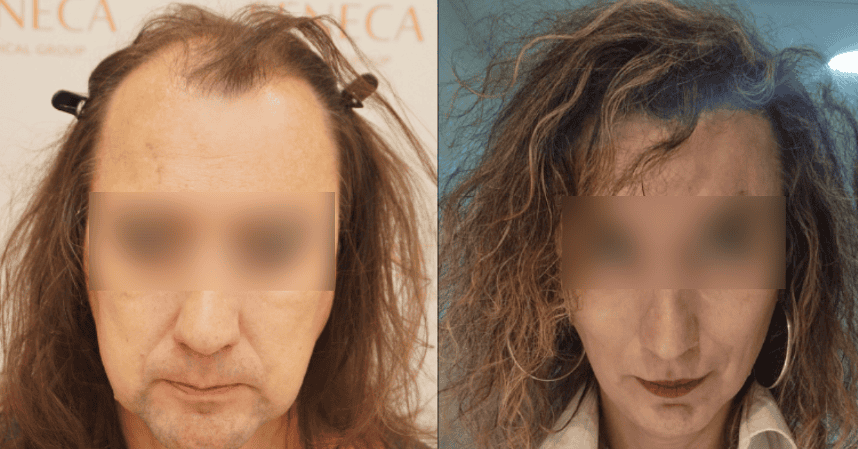
MTF hair transplant: Feminine hairline reconstruction
For many transgender women, the hairline is an important aspect of facial feminisation.
An MTF hair transplant can help create a softer, more rounded hairline by addressing temple recession, restoring density or adjusting the frontal hairline.
While hairline shapes naturally vary, a more feminine design may involve:
- Softening an M-shaped hairline.
- Filling in recessed temple areas.
- Creating a rounded, more even frontal hairline.
- Restoring hair density in thinning areas.
Feminising hormone therapy may help slow androgen-related hair loss, but it does not always restore hair follicles that have already been lost.
In such cases, MTF hairline surgery can be considered as an option for achieving the desired hairline shape.
At Seneca Medical Group, the focus is on creating a personalised hairline that complements each patient’s facial features and preferences, rather than following a standard design.
FTM hair transplant: Masculine hairline restoration
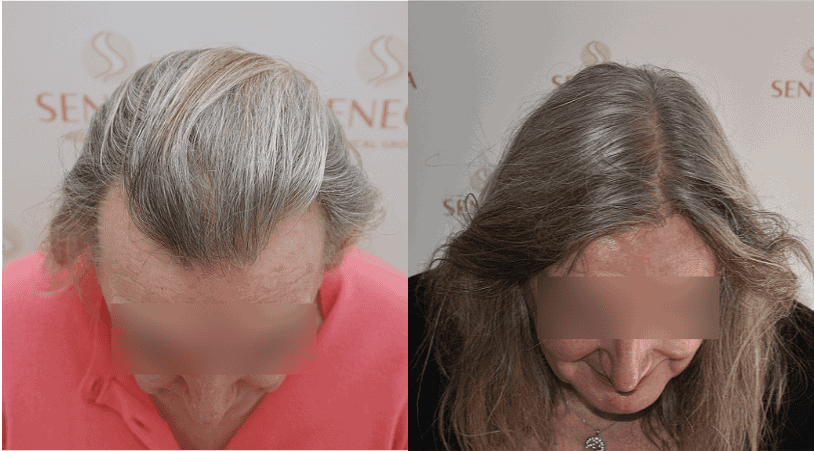
An FTM hair transplant can help transgender men address hair thinning, restore a receding hairline or achieve their preferred hairline shape.
Testosterone therapy can influence hair growth and may contribute to androgenetic alopecia (pattern hair loss) in genetically susceptible individuals.
This can lead to temple recession, frontal thinning or hair loss around the crown.
FTM hair restoration may help improve coverage in these areas while maintaining a natural-looking appearance.
Some patients prefer a straighter or more angular hairline, while others simply want to restore their existing hair density. For some transgender men, facial hair restoration, including beard or sideburn transplantation, may also be of interest.
Since hair loss can continue over time, particularly in patients receiving testosterone therapy, careful diagnosis and long-term treatment planning are essential.
How does transgender hair transplant surgery work?
At Seneca Medical Group, hair restoration is performed using the Direct FUE (Follicular Unit Extraction) technique.
With Direct FUE hair transplant surgery, individual hair follicles are extracted from the donor area and implanted into the areas requiring restoration using specialised instruments.
The procedure typically involves three main stages:
1. Consultation and hairline design
A specialist evaluates the patient’s hair loss, donor area, medical history and desired hairline shape to create a personalised treatment plan.
2. Hair follicle extraction
Healthy hair follicles are carefully extracted from the donor area, usually under local anaesthesia.
3. Hair follicle implantation
The follicles are implanted using a specialised implanter, with attention to their angle, direction and distribution to achieve natural-looking hair growth.
The number of grafts required depends on the patient’s hair characteristics and the extent of the area being treated.
How much does a transgender hair transplant cost in the UK?
The transgender hair transplant cost can vary depending on each patient’s individual needs and treatment requirements.
As a general indication, MTF and FTM hairline transplantation procedures in the UK may cost approximately £3,000 to £5,000.
This is an indicative price range rather than a fixed quotation. A personalised consultation is necessary to assess individual needs and provide a more accurate cost estimate. Book your online consultation and find out the exact cost tailored to you!
Recovery and results after a transgender hair transplant
Recovery following transgender hair transplant surgery is generally similar to other hair restoration procedures.
During the first few days, temporary redness, swelling or small scabs may appear around the treated areas. Following proper hair transplant aftercare helps support healing and protect the transplanted follicles.
Some transplanted hairs may shed during the first few weeks. This is an expected part of the hair growth process.
New hair growth typically becomes noticeable after three to four months, with gradual improvements in density over the following months. More complete results are often visible around 12 months, although individual recovery and growth rates vary.
For a more detailed explanation of the different growth stages,read about the hair transplant timeline.
Is transgender hair transplantation right for you?
Hair transplantation may be suitable for transgender individuals who wish to restore lost hair or reshape their hairline.
However, not everyone experiencing hair loss is necessarily a candidate for surgery.
Factors such as:
- donor hair availability,
- scalp health,
- medical history,
- ongoing hair loss
- hormone therapy
should be considered before treatment.
As with any surgical procedure, potential risks include swelling, infection, scarring or uneven hair growth. Results can vary, and further hair loss may occur in non-transplanted areas.
A specialist consultation helps determine whether transplantation or another hair loss treatment (e.g. PRP hair treatment) is the most appropriate option.
Personalised transgender hair restoration at Seneca Medical Group
At Seneca Medical Group, we understand that hair restoration is a personal decision and that every patient’s needs are different.
With 40 years of experience in hair loss research, diagnosis and treatment, our medical team focuses on personalised solutions using the Direct FUE technique.
Whether your goal is a softer, more feminine hairline, improved density or the restoration of a receding hairline, our approach begins with understanding your expectations.
We recognise that transgender and non-binary individuals may have different aesthetic preferences. Our aim is to provide professional guidance and develop a treatment plan that respects each patient’s individual goals.
Considering a transgender hair transplant? Book a consultation with Seneca Medical Group to discuss your needs and explore your hair restoration options.
FAQ:
Can transgender women get a hair transplant?
Yes. Transgender women can undergo hair transplantation to restore density, address temple recession or create a softer, more rounded hairline that complements their facial features.
Can transgender men have a hair transplant while taking testosterone?
Yes, depending on individual suitability. However, testosterone can contribute to ongoing pattern hair loss, so a specialist assessment is important when planning treatment.
Why choose Seneca Medical Group for hair restoration while taking testosterone?
With 40 years of experience in hair loss diagnosis and treatment, Seneca Medical Group offers a personalised approach to hair restoration. All hair transplant procedures are performed exclusively by doctors, ensuring medical expertise throughout the process. Each patient receives an individual assessment that considers their medical history, hair loss pattern, ongoing testosterone therapy and personal goals to determine the most suitable treatment options.
Is a transgender hair transplant permanent?
Transplanted follicles can provide long-lasting hair growth, although results vary. Existing non-transplanted hair may continue to thin over time.
Can non-binary individuals undergo hairline reconstruction?
Yes. Hairline reconstruction can be tailored to non-binary individuals without following traditionally masculine or feminine hairline designs. The treatment should reflect each person’s individual preferences.