UK
 GR
 EU
 HE
 FR
September 18, 2026
Hair doesn’t grow continuously. Each strand follows its own natural cycle of growth, transition, rest and shedding before the process begins again.
Because every follicle follows this cycle independently, some hairs are actively growing while others are resting or shedding. This is completely normal and explains why we naturally lose some hair every day.
The hair growth cycle is usually divided into four stages: Anagen, Catagen, Telogen and Exogen. Check out the analytical description of the hair growth cycle below.
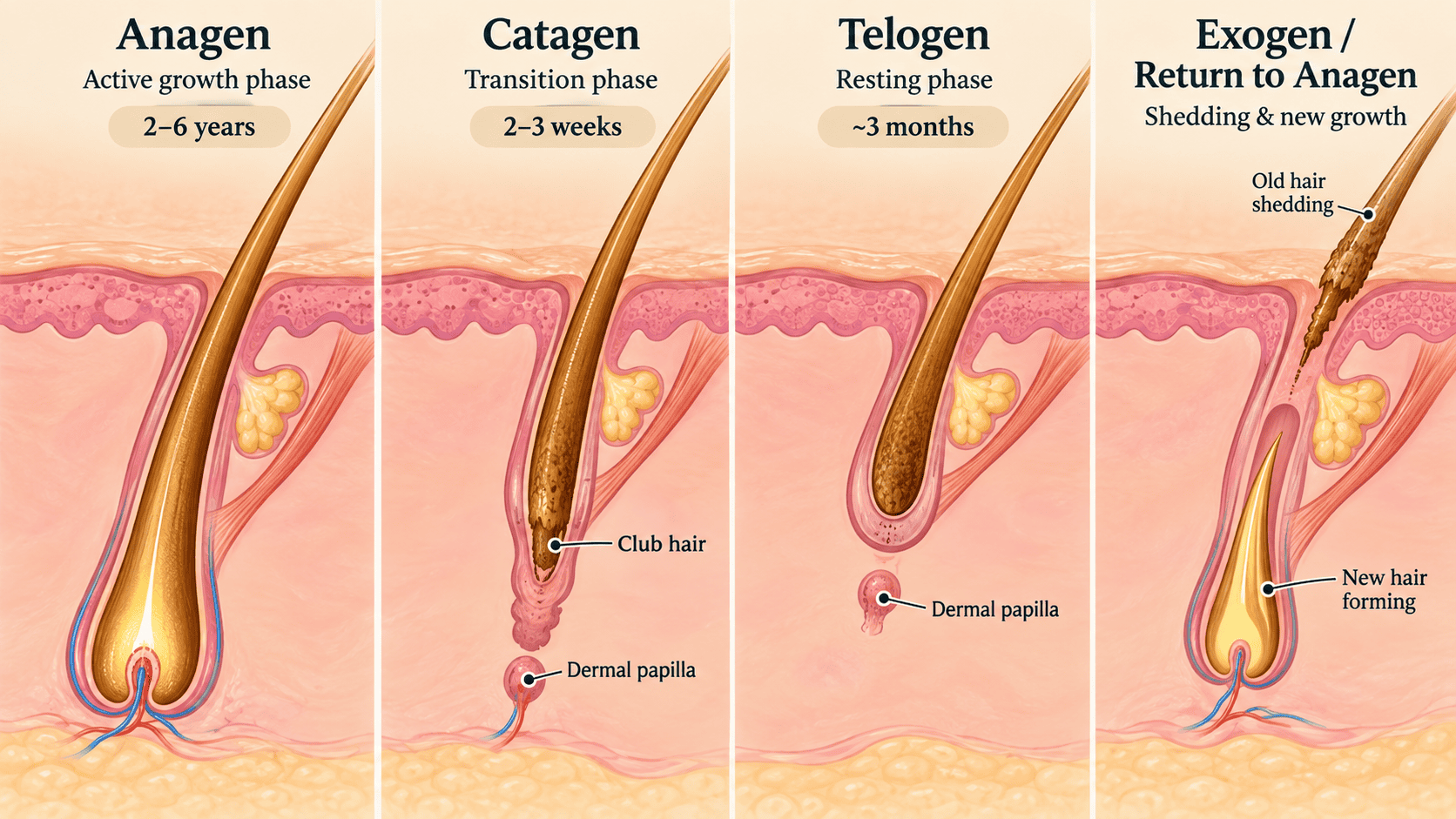
Phase 1 – Anagen: the active growth phase
Anagen is the longest phase of the hair cycle and the period when hair actively grows.
On the scalp, it usually lasts around 2 to 6 years. Most healthy scalp hairs are in this phase at any given time.
The length of Anagen is influenced by factors such as genetics, age, hormones and overall health. Eventually, growth slows and the follicle moves into the next stage.
Phase 2 – Catagen: the transition phase
Catagen is a short transition phase that usually lasts around 2 to 3 weeks.
Hair growth stops, the lower part of the follicle shrinks and the hair begins to separate from the structures that supported its growth.
Only a small percentage of scalp hairs are in Catagen at the same time.
Phase 3 – Telogen: the resting phase
Telogen is the resting stage of the hair growth cycle and generally lasts around 2 to 3 months.
The hair is no longer actively growing but usually remains in the follicle while it prepares for the next growth cycle.
Towards the end of Telogen, a new hair may begin developing beneath the existing one, preparing the older hair to be shed.
Phase 4 – Exogen: the shedding phase
Exogen is the stage when the old hair is released from the follicle and falls out.
You may notice these hairs when washing or brushing your hair, on your pillow or when running your fingers through it.
In general, losing around 50 to 100 hairs per day can fall within the normal range. Once the old hair is shed, the follicle can return to Anagen and begin producing new hair.
So, how long is the hair growth cycle?
Overall, the hair growth cycle can take around 2 to 7 years to complete, although the exact timeline varies from person to person. Most of this time is spent in the Anagen growth phase, while Catagen, Telogen and Exogen are considerably shorter. Once the shedding stage is complete, the follicle can begin a new cycle and return to active growth.
Why can hair shedding suddenly increase?
Illness, fever, significant weight loss, hormonal changes, childbirth and physical or emotional stress can cause more follicles than usual to enter the resting phase at the same time.
A common example is telogen effluvium. Shedding may not begin immediately after the trigger and can become noticeable weeks or even months later.
This delay is one reason why the connection between stress and hair loss is not always obvious.
In many cases, increased shedding is temporary and the hair cycle gradually returns to normal once the underlying trigger has resolved.
Is shedding the same as hair loss?
Not necessarily.
Normal shedding happens when a hair reaches the end of its natural cycle and is eventually replaced by new growth.
Progressive hair loss works differently. In conditions such as androgenetic alopecia, follicles can gradually become smaller and spend less time in Anagen, producing hairs that are finer, shorter and less visible.
Over time, this may lead to thinning, reduced density or changes in the hairline. A gradually changing frontal hairline, for example, may be worth assessing. Our guide to what a normal male hairline looks like explains these changes in more detail.

What happens to the hair cycle after a hair transplant?
Transplanted follicles continue to follow the same natural growth cycle.
After a hair transplant, some transplanted hairs commonly shed during the first weeks. The visible hair shaft may fall out while the follicle remains in place.
After a resting period, the follicle can enter a new Anagen phase and begin producing new hair. This is why hair transplant results develop gradually.
For suitable patients with permanent hair loss, Direct FUE hair transplantation can redistribute healthy follicles from the donor area to areas affected by thinning or hair loss.
When should you pay attention to hair shedding?
Some shedding is part of healthy hair renewal. What matters most is whether you notice a significant change from what is normal for you.
Persistent shedding, reduced density, a receding hairline or increasing scalp visibility may be signs that your hair should be assessed.
A professional assessment can help distinguish between normal shedding, a temporary disruption of the hair cycle and progressive hair loss.
Concerned about hair loss or increased shedding?
If you have noticed changes in your hair and are unsure whether they are part of the normal hair cycle, a professional assessment can help identify what may be happening.
Get a clear assessment of your hair and scalp with a free online diagnosis from Seneca Medical Group.